Can a Manufacturer Use an AI-Generated Bottle Image to Create a Mold and Start Mass Production?
Type “elegant amber perfume bottle with faceted glass and gold cap” into an AI image generator and in ten seconds you’ll get something that looks like it belongs on a luxury store shelf. It’s tempting to assume the next step is simple: send that image to a glass manufacturer, and they cut a mold from it.
They can’t. Here’s why — and what actually has to happen between “I love this look” and a bottle rolling off the production line.
The AI image is a picture, not a part
An AI-generated render is built to satisfy the eye. It gets the lighting, the reflections, the mood right, because that’s what the model was trained to optimize. It was never trained to obey the rules glass has to obey when it’s hot, moving through a mold, and cooling under gravity.
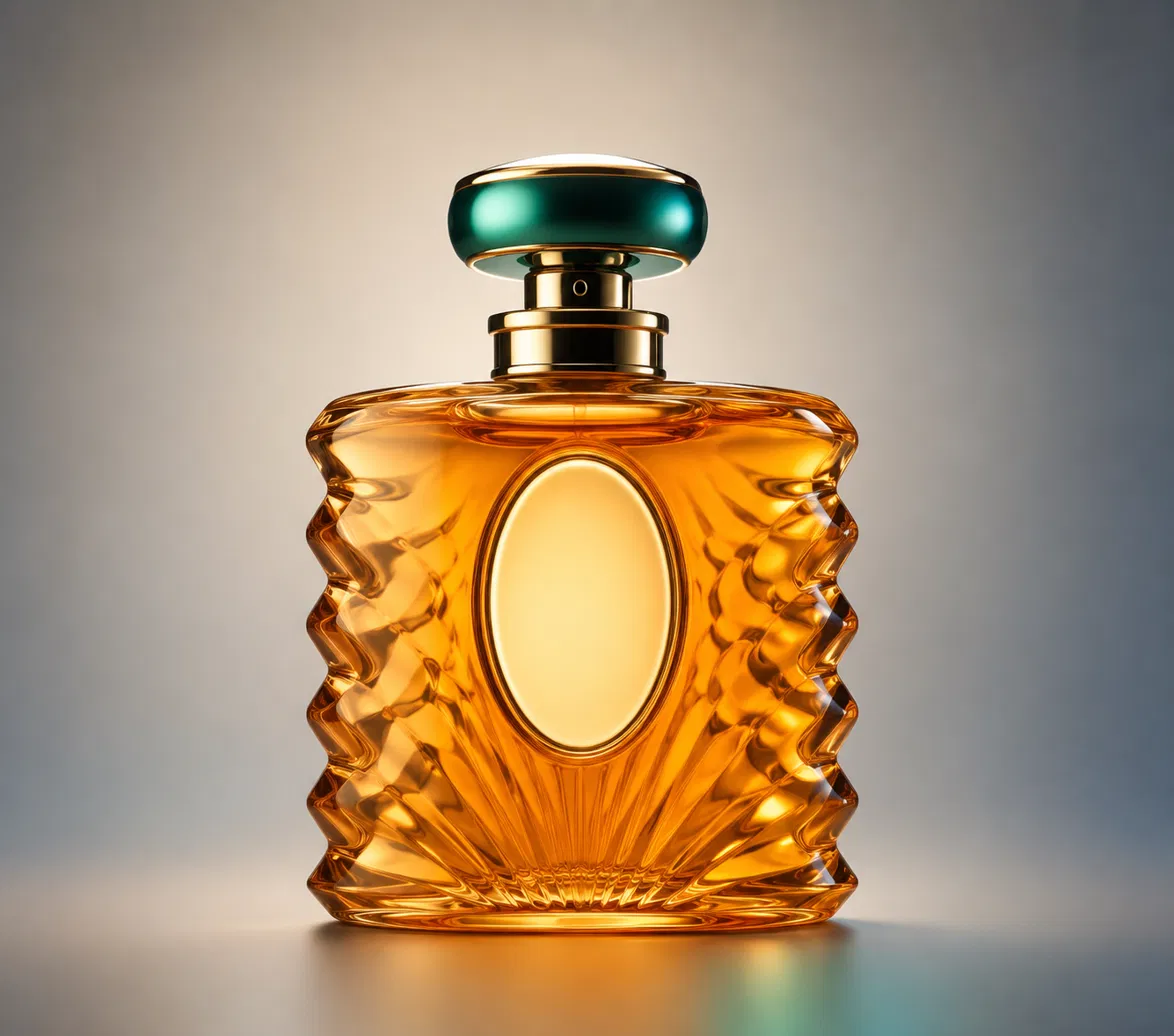
Look closely at a typical AI bottle render and you’ll usually find:
- No neck finish standard. Every cap, pump, or sprayer is built to fit a defined neck finish (PP28, GPI 20/410, and so on). An AI image just draws “a cap” — it has no idea what thread or sealing surface is underneath.
- No wall thickness. Glass needs a controlled, even wall thickness to cool without cracking or warping. AI renders don’t have a wall at all — they have a surface.
- No draft angle. Every panel on a mass-produced glass bottle needs a slight taper so the piece releases cleanly from a metal mold. AI-generated facets are often drawn as perfectly vertical or even undercut — geometry that would lock the bottle inside the mold.
- No weight or capacity spec. Fill volume, glass weight, and center of gravity all affect stability, cost, and shipping — none of which an image can specify.
- Inconsistent geometry. Look at the two sides of an AI bottle and they’re rarely mirror-perfect. A real mold is CNC-machined from an exact, symmetrical 3D model; an AI image just approximates symmetry well enough to fool the eye.
None of this is a flaw you can point to and say “fix that one thing.” The image simply doesn’t contain the information a toolmaker needs, because it was never engineered — it was generated to look convincing in a thumbnail.
What a manufacturer actually needs
Before a mold shop will quote a job, they need two deliverables, not one image:
- A 2D manufacturing drawing — every dimension, wall thickness, draft angle, neck finish callout, and tolerance, dimensioned the way a machinist or moldmaker reads it.
- A 3D CAD model — a real, watertight solid (SolidWorks, AutoCAD, or similar) built with correct draft on every surface, used directly for CNC mold cutting or 3D-printed prototyping.
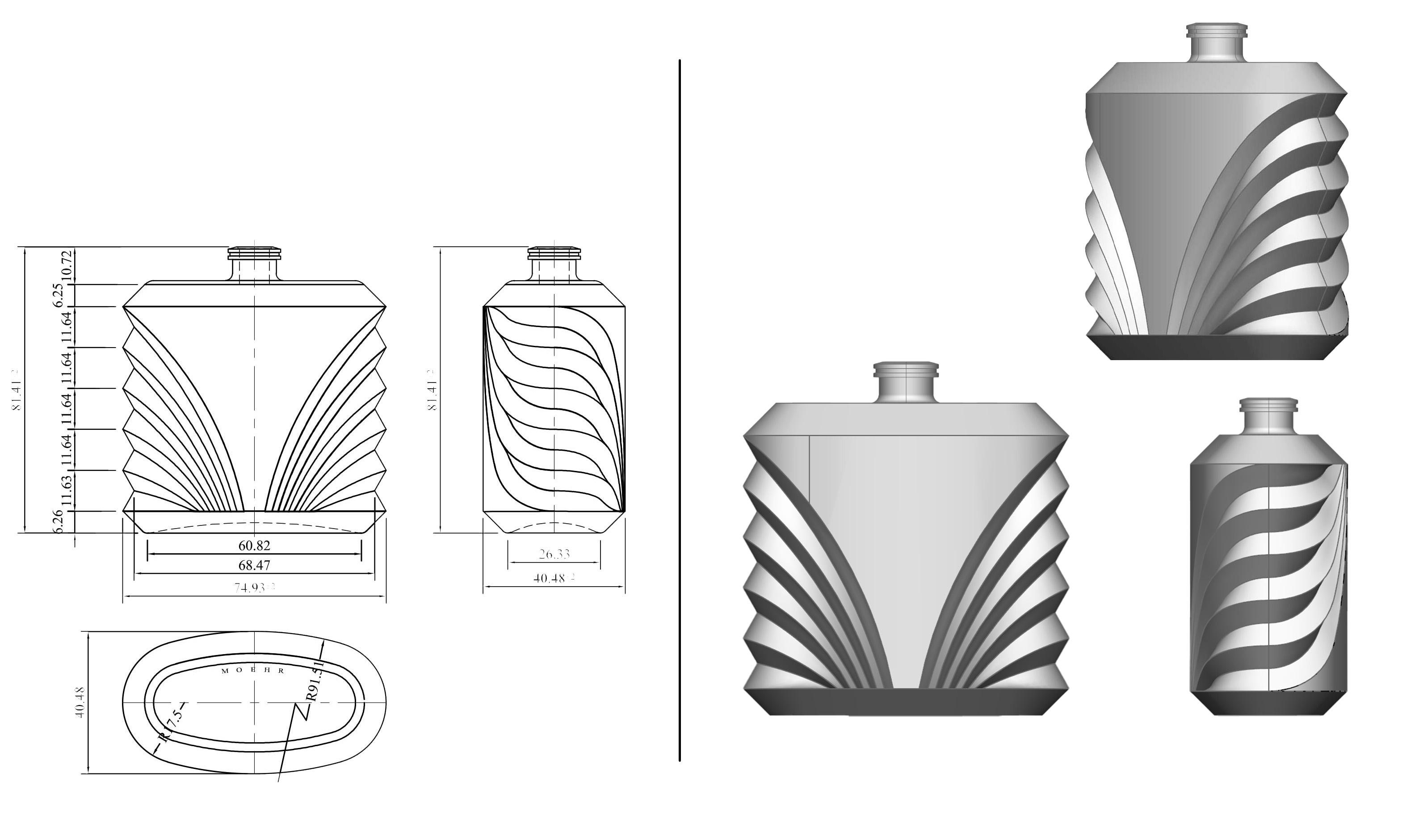
This is the translation step: taking the idea captured in a concept image (AI-generated or otherwise) and re-engineering it as a real, moldable object. The overall silhouette, the mood, the faceting pattern — all of that can be preserved. What changes is that every surface now has a reason and a number behind it.
So is the AI image useless?
Not at all — it’s a great starting point for creative direction. It tells a designer what look you’re after: proportions, finish color, faceting style, cap design language. What it can’t do is skip the engineering step in between concept and production.
If you already have an AI concept you like, the practical next move is having it converted into a proper manufacturing drawing and CAD model — checked for moldability, correct draft, standard neck finish, and realistic wall thickness — before it ever reaches a glass manufacturer’s desk.
That’s the difference between a bottle that looks right in a render and one that actually comes off a production line.