How Much Does a Custom Glass Bottle Mold Cost? (Real Numbers from 14 Years in the Industry)
It’s the first question almost every founder asks me — usually in the first five minutes of a call:
“So… how much will the mold cost?”
And it’s a fair question. The mold is the gateway to owning a custom bottle. Yet if you search for real numbers online, you’ll find almost nothing — manufacturers guard their pricing, and most design articles dodge the topic entirely. After 14+ years designing glass packaging and preparing mold-ready CAD for factories, I’m going to give you the honest picture: what molds actually cost, why the price varies so much, and where founders waste money without realizing it.
First, What Exactly Are You Paying For?
A glass bottle mold isn’t one piece of steel. For standard blow-and-blow or press-and-blow production on an IS (Individual Section) machine, a complete mold set typically includes:
- Blank molds — where the initial glass gob is formed into a parison
- Blow molds — where the parison is blown into the final bottle shape (this is the part carrying your design)
- Neck rings — forming your bottle’s neck finish so caps and corks fit
- Baffles, plungers, and bottom plates — completing the set
And here’s the detail that surprises everyone: factories don’t run one cavity at a time. A production line runs multiple sections simultaneously, so you’re usually buying multiple identical mold sets — commonly 4 to 8 cavities’ worth — machined from cast iron or steel alloy, each polished to give your glass its final surface quality.
That’s why a “mold” isn’t a $500 purchase. You’re commissioning precision tooling.
The Real Numbers
Every factory prices differently, and your design’s complexity moves the needle a lot. But based on the projects I’ve worked on, here are realistic ranges for a complete production mold set:
Simple custom bottle (round, minimal decoration):
Roughly $1,500–$2,500 for tooling at Asian manufacturers; European and American mold shops typically run 2–3× higher for the same tooling.
Moderate complexity (custom silhouette, embossed logo, standard neck):
Roughly $2,500–$3,500 in Asia; premium mold makers in Europe can exceed $5,000–$8,000.
High complexity (deep fluting, sculpted panels, heavy decorative bases, unusual geometry):
$10,000–$12,000+, sometimes requiring specialized polishing and extra sampling rounds.
(Treat these as planning ranges, not quotes — glass weight, cavity count, mold material, and the individual factory all shift the final figure. Part of my job is designing so your bottle lands in the lowest possible bracket for its look.)
The Five Factors That Move Your Mold Price
1. Design complexity. Every surface detail — embossing, fluting, sculpted shoulders — adds machining and polishing hours. A dramatic look doesn’t have to mean a dramatic price, but how the detail is engineered matters enormously. Vertical fluting that extracts cleanly from the mold costs far less than a design fighting the extraction direction (I explained why in my article on why AI-generated bottle designs can’t be manufactured).
2. Number of cavities. More cavities = faster production and lower per-bottle cost, but higher upfront tooling investment. Small runs might use 2–4 cavities; large-scale production uses 6–12.
3. Mold material and expected lifespan. Cast iron molds are cheaper but wear faster; alloy and nickel-coated molds cost more upfront and survive far more production cycles. If you’re planning repeat orders, better material pays for itself.
4. Neck finish. A standard GPI/GCMI neck uses proven neck-ring designs the mold shop has made hundreds of times. An exotic custom closure means custom neck tooling — and often custom cap tooling on top. This is one of the most expensive “invisible” decisions in bottle design.
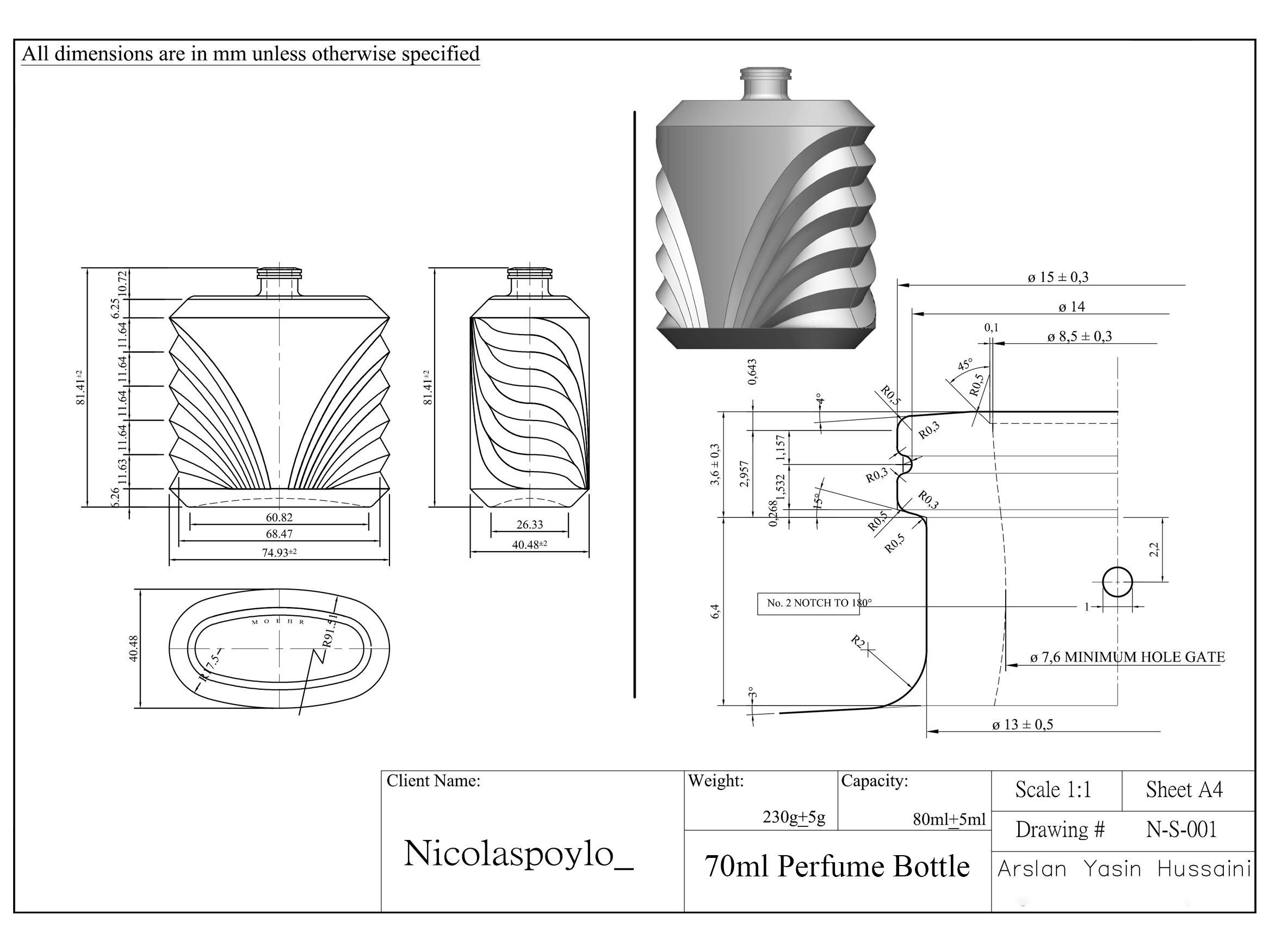
5. The quality of your technical drawings. This is the factor nobody talks about. When a factory receives a fully dimensioned 2D manufacturing drawing with capacity calculations, glass weight, tolerances, and a proper 3D CAD model, they quote accurately and cut steel once. When they receive a pretty picture, they either refuse to quote, pad the price for risk — or worse, interpret your design themselves and you pay for revision after revision. Bad input documents can quietly add 20–30% to your tooling journey.
Don’t Forget: The Mold Is Only Part of the Equation
Founders often budget for the mold and get blindsided by the rest:
- Minimum order quantities. Custom molds come with MOQs — commonly 5,000–20,000 bottles at flexible Asian factories, and 50,000–100,000+ at large automated plants. Your mold might cost $3,000, but your first production run is its own investment.
- Sampling. Before full production, the factory runs samples off your new mold. Expect a sampling round (sometimes two) with associated costs and a few weeks of lead time.
- Timeline. Mold machining typically takes 4–8 weeks after design approval, plus sampling, plus your production slot. From finished design to bottles-in-hand, plan for 3–5 months.
How to Keep Your Mold Cost Down (Without Killing the Design)
After years of sitting between brands and factories, these are the levers that genuinely work:
- Standardize the neck. Use a GPI/GCMI finish. Save your uniqueness for the body, where customers actually see it.
- Engineer decoration for extraction. The same premium look, oriented correctly for the mold, can cut tooling cost dramatically. This is exactly the kind of decision made at the CAD stage — not at the factory.
- Right-size your cavity count. Don’t pay for 8 cavities when your launch volume justifies 4. You can add tooling when you scale.
- Arrive with manufacturing-ready drawings. Complete 2D drawings and 3D CAD let factories compete on price for identical, unambiguous tooling — which is how you get honest quotes instead of padded ones.
The Bottom Line
A custom glass bottle mold is a real investment — typically $1,500 to $12,000+ depending on complexity and where it’s made — but it’s a one-time investment that gives your brand something no stock bottle ever will: a shape competitors can’t buy from a catalog.
The smartest money you’ll spend in the whole process isn’t on the steel. It’s on making sure the design that reaches the mold shop is engineered right the first time — correct draft angles, calculated glass distribution, standard neck finish, full dimensions. That’s the difference between one round of tooling and an expensive learning experience.
If you’re planning a custom bottle and want to know what your design would realistically cost to tool, I’d be happy to take a look. I deliver the complete manufacturing-ready package — dimensioned 2D drawings, 3D CAD models for mold making, and photorealistic renders — that lets factories quote you accurately. Reach out through my contact page or explore recent work on my glass bottle design portfolio.